

There are now more active smartphone subscriptions on Earth than there are people. Mobile devices account for over 60% of all global web traffic, and in many African markets — Nigeria, Kenya, Ghana — that figure exceeds 80%. For businesses that have not yet built a dedicated mobile app, the message is unambiguous: your customers are mobile-first, and your business needs to meet them there.
But a mobile app is not just about following a trend. Done correctly, a custom business app is one of the highest-return technology investments available to growing companies.
What a Mobile App Does That a Website Cannot
Many business owners assume a mobile-responsive website is a sufficient substitute for a native app. In terms of functionality, the gap has narrowed — but in terms of user experience, it has not.
A mobile app lives on your customer's home screen. It sends push notifications. It works offline. It accesses the device camera, GPS, and biometrics directly. It loads faster because it stores data locally. And most critically, it keeps your brand a tap away rather than buried somewhere in a browser tab.
Research by Adjust and Google consistently shows that mobile app users engage more frequently, convert at higher rates, and generate significantly higher lifetime value than mobile web users for the same product.
Business Benefits of Having a Dedicated Mobile App
Higher Customer Retention
Apps with push notification capability retain users at rates 3–4x higher than mobile websites. A well-timed, personalised notification — a flash sale, a delivery update, a loyalty reward — brings customers back into your product with zero cost per message after the initial build.
Faster, Smoother User Experience
Native and cross-platform apps render UI at the device's native speed. There are no round-trips to a server for every interaction. Customers do not wait, and customers who do not wait do not leave.
Direct Revenue Opportunities
In-app purchases, subscription management, and one-tap checkout are all significantly more effective inside a dedicated app than through a mobile browser. The friction that causes customers to abandon carts on mobile websites is dramatically reduced in an app environment.
Valuable First-Party Data
Every interaction inside your app — screens viewed, features used, time spent, items searched — is data you own. Unlike third-party platforms where you are a tenant, your app gives you direct insight into how customers actually behave, enabling you to improve your product and personalise your service over time.
Competitive Differentiation
In most sectors across Africa and emerging markets, the majority of SMEs do not yet have a dedicated app. Being the business in your niche that offers a polished mobile experience is a meaningful differentiator — one your competitors will struggle to replicate quickly once you have it.
Native vs Cross-Platform: Choosing the Right Approach
This is one of the most common questions businesses face when starting an app project.
Native development (Swift for iOS, Kotlin for Android) produces the highest-performance apps with full access to all platform capabilities. It is the right choice for apps with highly complex interactions, demanding performance requirements, or features that depend heavily on platform-specific hardware.
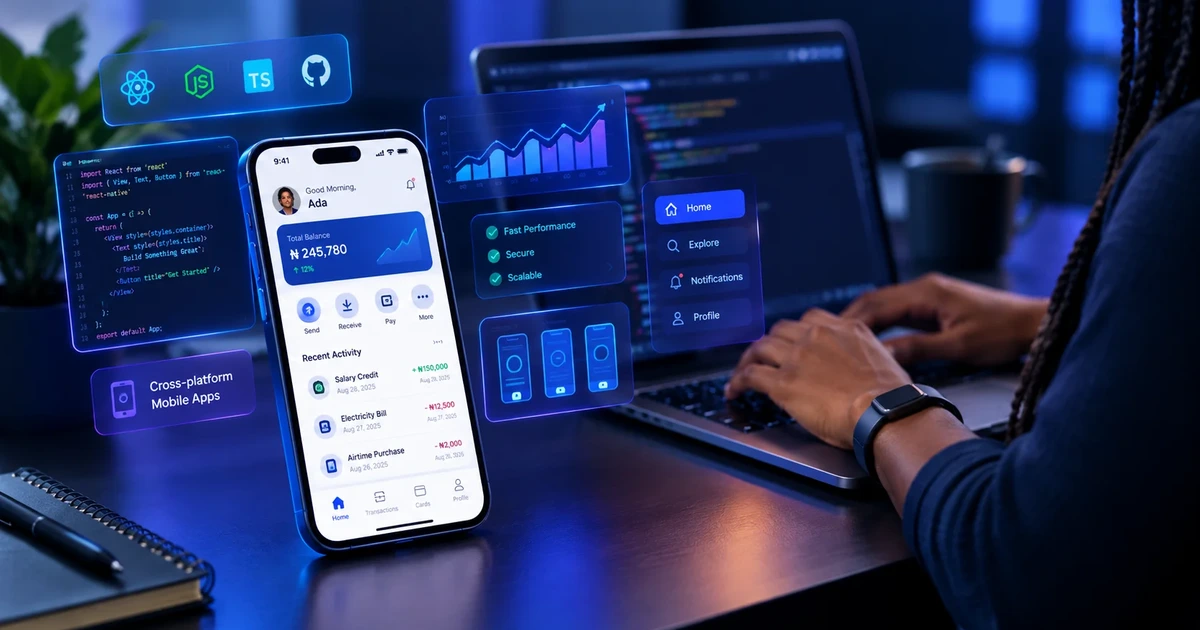
Cross-platform development (React Native, Flutter) allows a single codebase to produce apps for both iOS and Android simultaneously. For the vast majority of business applications — customer portals, e-commerce apps, service booking, internal tools — cross-platform is the faster, more cost-effective choice without meaningful trade-offs in user experience.
At Cyfamod, we primarily build cross-platform applications using React Native, which allows us to deliver high-quality iOS and Android apps at a pace and cost that makes sense for growing businesses.
What Makes a Mobile App Project Succeed (or Fail)
From a quality assurance perspective, the most common causes of failed app launches are entirely preventable:
- Skipping user testing. Apps that launch without real user feedback on the interface almost always require expensive redesigns within months. Testing with actual users — not just internal stakeholders — before launch is non-negotiable.
- Neglecting performance on mid-range devices. Your power users may have flagship phones, but your average customer does not. Apps must be tested across a range of devices and network conditions.
- Insufficient regression testing during updates. A new feature that breaks an existing one is worse than not shipping the feature at all. Every release cycle needs a defined test scope.
- No analytics instrumentation. If you cannot measure how users move through your app, you cannot improve it. Analytics must be built in from day one.
What to Look for in a Mobile App Development Partner
When evaluating development partners, look beyond portfolio aesthetics. Ask:
- Do they have a defined QA and testing process, or do they rely on developers to test their own code?
- How do they handle post-launch bugs and updates?
- Do they build for maintainability, or will you need to rebuild in two years?
- Can they show you real performance metrics from apps they have shipped?
A development partner that takes quality assurance seriously will always outperform one that treats testing as an afterthought.
Shipping with Quality and Intent
A successful mobile presence requires balancing rapid feature delivery with uncompromising stability, battery efficiency, and intuitive design. By investing in comprehensive automated testing, actionable telemetry, and clean architecture from version 1.0, engineering teams position their apps to scale smoothly as adoption expands.